Måns Jakob
The EmigrantsMåns Jakob is an elderly farmer from Öland who emigrates aboard the Charlotta with his wife, Fina-Kajsa, intending to join their son in America. He is remembered less for a prominent role in the group’s decisions than for his unwavering concern about a grindstone he is carrying to his son. When Måns Jakob dies at sea, that ordinary piece of equipment becomes a measure of the distance between the family’s plans and the voyage’s mortal risks: the son may receive neither his father nor the tool he needed.
Identity and Departure
Måns Jakob and Fina-Kajsa are an old, helpful peasant couple from Öland among the passengers in the family compartment. They leave their farm because their son in North America has written persuasively, although Fina-Kajsa had wanted to remain at home. She later reflects that they had already spent more than sixty years safely on land and questions whether they should have undertaken the crossing at their age. Their decision is therefore both a family reunion plan and a departure made under conditions of uncertainty: the new country is known to them through their son’s letters, not firsthand experience.
At the meeting place before the journey south, the emigrants number sixteen—nine adults and seven children—and Jonas Petter calls them a family of suitable size. Måns Jakob belongs to this collective undertaking, but the story gives his particular passage its own focus through the burden he has chosen to transport. His connection to the migration is not an abstract hope of finding land; it is also the effort to carry a useful object to a son already settled across the ocean.
The Grindstone and the Household Journey
The grindstone weighs heavily on Måns Jakob’s mind. He worries that it could be damaged in the ship’s hold and wonders how he will get it to his son after landing, or whether freight in America will cost too much. His son has told him that American stones are expensive and poor, making this one a practical answer to a specific difficulty: without it, the son cannot sharpen his axes properly. Måns Jakob’s insistence that the stone arrive safely persists even when his own arrival seems uncertain.
The object is part of a larger world of household preparations in which departure means choosing what can travel and leaving much behind. The Nilsson family’s old oak clothes chest, which had served generations at baptisms, weddings, and funerals, is brought down from the attic to become a strong packing case. Other emigrants pack tools, clothing, bedding, food, and implements for work in the new country. Against this practical inventory, Måns Jakob’s stone stands out for the anxious attention he gives it: the tool is valuable not merely as freight, but because it is meant for his son and has a clear use in the life awaiting him.
His concern also persists when the crossing renders ordinary travel plans uncertain. As he lies seasick in his bunk, he fears the grindstone has broken and become useless. His illness is severe, and Fina-Kajsa, herself suffering, remains beside him and tends to him. The repeated worry links his hopes for his son to his immediate vulnerability aboard the ship: even in delirium, he is preoccupied with whether the stone will reach its destination.
Death at Sea
A few days later, Måns Jakob is found dead in his bunk. Fina-Kajsa first refuses to believe it. She shakes him as she had done on other mornings when he was slow to wake, recalling his heavy sleep and the occasions when his heart seemed to stop briefly. Danjel Andreasson tells her that her husband has died, but familiarity with their shared life makes her persist in trying to rouse him. The scene gives his death the scale of a household rupture: before it is an event for the whole passenger group, it is the familiar absence of a husband who does not answer his wife.
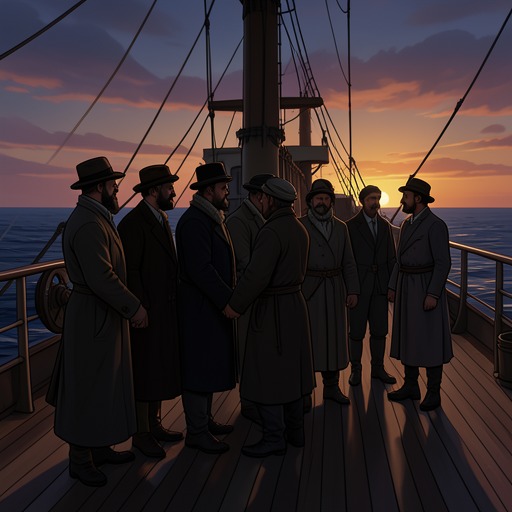
The passengers prepare his body for burial at sea. Karl Oskar and Danjel wash his face with seawater and old cloths before he is enclosed in a shroud; they understand this as a final duty to a dead person whose body had served as the dwelling of a human soul. The mate places a weight in the canvas. Karl Oskar thinks of the grindstone in the storeroom and wonders what will become of it without its owner, imagining that Måns Jakob might have wanted the stone beside him at the bottom of the sea, beyond further worry over its fate.
The burial alters the living passengers’ arrangements as well as marking a death. Fina-Kajsa, now a widow, moves across the sailcloth partition to the unmarried women’s side. The space occupied by the old couple becomes available to others, and Karl Oskar moves into the bunk Måns Jakob has vacated. The passage’s blunt practical consequence—one deathbed becomes another passenger’s sleeping place—makes shipboard life continue even as the group grieves.
Legacy and Narrative Significance
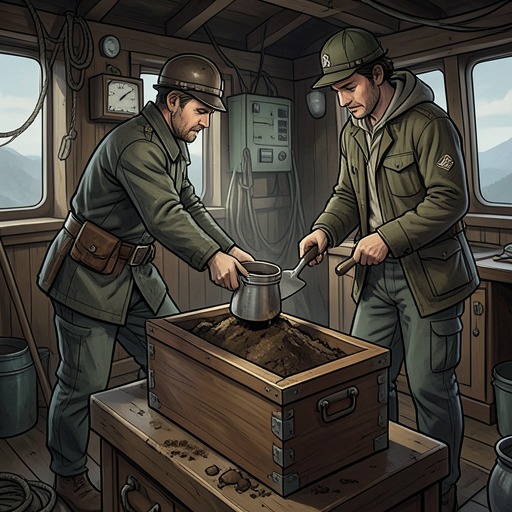
Three shovelfuls of Swedish earth are taken from the ship’s supply and used in the sea burial. The ritual gives Måns Jakob a final connection to the homeland he left, but the earth does not hold him on land: the canvas-covered body is committed to the water, and some of the soil later slips over the rail into the sea. His death thus joins the novel’s recurring contrast between the familiar ground of home and the uncertain, in-between world of the crossing.
Måns Jakob’s story also gives migration a material and familial measure. The grindstone is carried across the ocean for a son whose need is concrete, yet the father dies before completing the delivery. The tool survives as cargo after the person whose care defined its journey is gone; in the ship’s hold, it becomes an object without its intended owner. Through this reversal, the passage makes the emigrants’ hopes neither triumphant nor merely speculative: they are bound to useful possessions, distant relatives, and plans that the sea may interrupt without warning.